

Here are ten compelling reasons why meditation is one of the most valuable tools to build into your life.
No More
Insomnia
“Since I started meditating I’ve been
sleeping beautifully every night.”
CHLOE, DIRECTOR
sleeping beautifully every night.”


Meet the Teachers

We’re Jillian Lavender and Michael Miller, founders of London Meditation Centre.
We teach Vedic Meditation in London and New York and have introduced thousands of people to this practice, alongside running retreats across the world.
Jillian is the author of Why Meditate? Because it Works and Do Reset. Michael hosts the podcast Speaking of Meditation. We’re passionate about teaching meditation that is easy, practical and that works.
In the Press








an essential part of my day.”

balanced person.”
FAQs
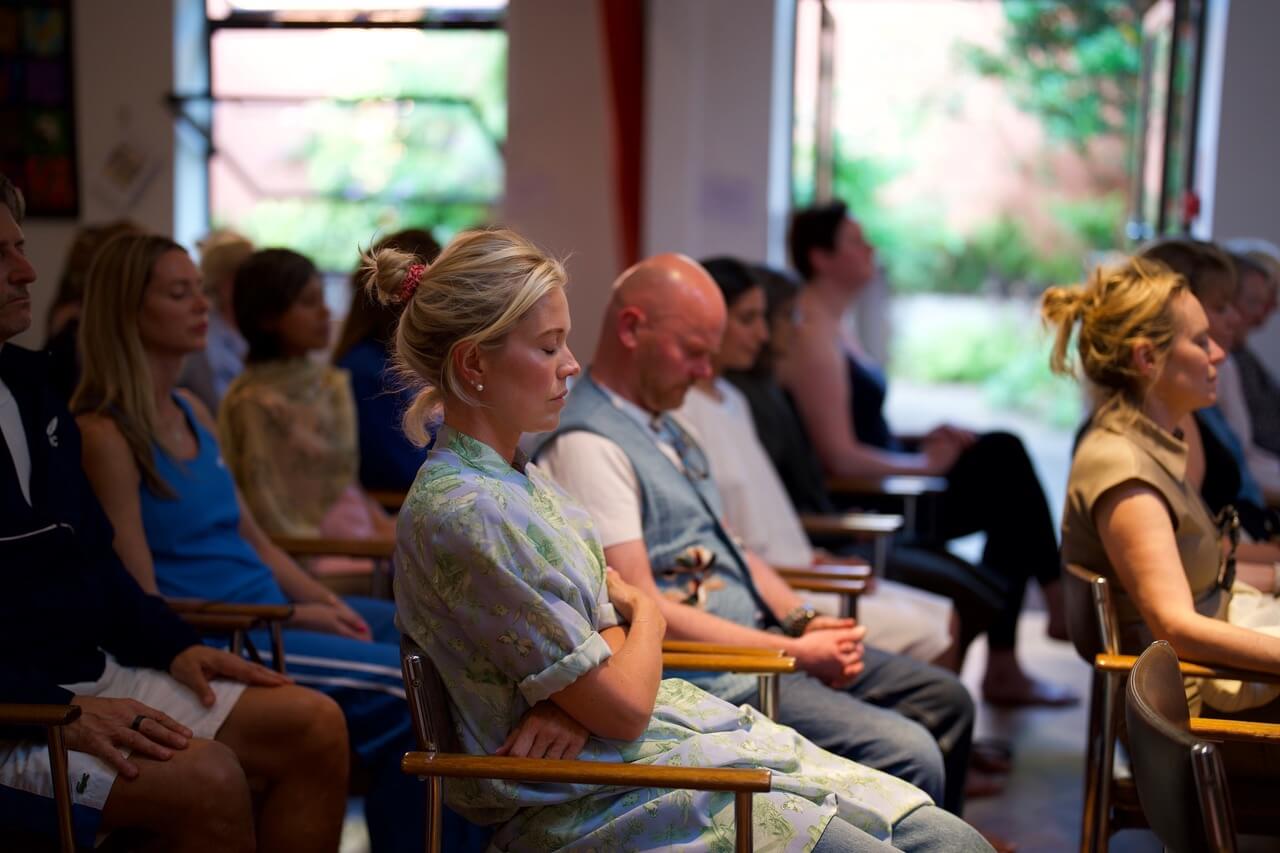
Vedic Meditation is a simple and natural way to settle down the mind and rest the body deeply.
In Vedic Meditation you learn a very specific sound called a mantra. The mantra is a meaningless sound that’s chosen for each meditator by their teacher. It is a particular pulsation of sound that’s resonant with the thinker. Certain sounds work best for certain groups of people.
You close the eyes and silently begin to think the sound. Immediately and spontaneously, it becomes fainter and begins to quieten down. As you gently repeat it internally, the sound becomes more soft and subtle until a point is reached where it’s almost imperceptible. And then it does its last little trick, and it disappears, and for a moment the mind falls quiet. The mind drops into an inner, serene state. You’re conscious and awake and yet you’re not thinking. Those moments don’t tend to last so long and often you’re not even aware it’s happening.
When the mind quietens down, the body follows. Within a few minutes of meditating your body is resting much deeper than sleep. This unprecedented rest is one of the key benefits of Vedic Meditation. And it’s what makes it different to other techniques.
When you get that kind of deep rest, the body can release tiredness and tension. You come out of meditation feeling energised and ready to go. Old stresses and anxiety are released – you feel clearer, calmer and more aware.
Vedic Meditation is very different to a mindfulness practice.
Let’s start with a definition of what it means to be mindful:
Mindfulness means to be in the present, fully engaged with whatever is happening in the moment – aware of thoughts but not distracted by them.
Given the aim is to be in the moment, how do we stay present and not get overwhelmed by all the noise in our head?
Mindfulness practices use many different approaches. Some are done while walking, others sitting quietly and others are practised while engaged in an activity, like washing the dishes. They all involve monitoring whatever’s happening with the aim of staying in the present moment. Notice how the body feels, the contact point of the feet with the ground, the feel of the air on the skin, watch the breath and observe thoughts as they float through the mind. Try not to drift into the past or begin planning and speculating about the future.
It takes effort to hold the attention in this way. Thoughts may settle down, but the mind is still engaged in thinking and the body is active to some degree.
Vedic Meditation works differently.
Rather than being a practice of trying to stay in the moment, Vedic Meditation is effortless. You close your eyes and silently repeat a mantra. Your mind automatically settles down to its least-excited state and your body rests profoundly. As a result, you release stress and tiredness.
This is the key to becoming more mindful in life. Because stress and fatigue block our ability to be fully awake and present. Having dissolved those blockages during meditation, you come out more available to perceive what’s actually going on. You’re more mindful. In this way, present moment awareness is an outcome of meditation.
Of course everyone’s personal situations are unique, and in our experience, students begin to notice changes while on the first few days of the course.
This rapid progress is because Vedic Meditation is a natural technique. That means it’s easy and everyone can do it. We get you meditating on the first day of the course and then we get very clear about how to meditate correctly so you know you’re doing it right.
Most people report feeling calmer, more energised and more focused within the first couple of weeks of meditation.
Have a question of your own? Ask us at our next Intro Talk.
It’s free. And no commitment required.
Step 1: Register for our free online Intro Talk
Step 2: Join the in-person Meditation Course
About The Online Intro Talk
In this hour-long session we’ll cover:
- Who we are and how we teach
- Why Vedic Meditation will work for you
- How it’s different from other styles like mindfulness
- What the science and research say about meditation
Please note: We will use information submitted here to stay in contact with you regarding our services. For details, see our Privacy Policy.
London Meditation Centre seems to
operate with generosity at its core.”